INDIVIDUAL RESEARCH
Perceived Authenticity of Musical Performance
A comparative study of human, MIDI, and AI-generated audio
Hiring instrumentalists can be expensive, especially for independent producers working with limited budgets. I wanted to find out whether an AI-generated performance could be a convincing alternative, and whether listeners would still prefer it once they knew how it was made.
Motivation
AI-generated instrumental parts offer a potential alternative to hiring musicians when recording budgets are limited. I wanted to examine whether listeners found these performances convincing, and whether knowing the source changed their preferences.
I compared human, MIDI, and Suno versions of two short pieces I wrote. Ten listeners first judged them without source labels, then chose again after learning how each had been made. The comparison considered both the sound of the performance and how closely it followed the written part.
Preparation
Each piece used the same melody and accompaniment across the three versions: flute with a synthesized pad in A minor at 76 BPM, and violin with piano in D major at 120 BPM.
The arrangements began in Ableton Live, using Kontakt 8 and Omnisphere 3. I shaped the solo MIDI parts with velocity and volume automation rather than leaving the notes at uniform dynamics.
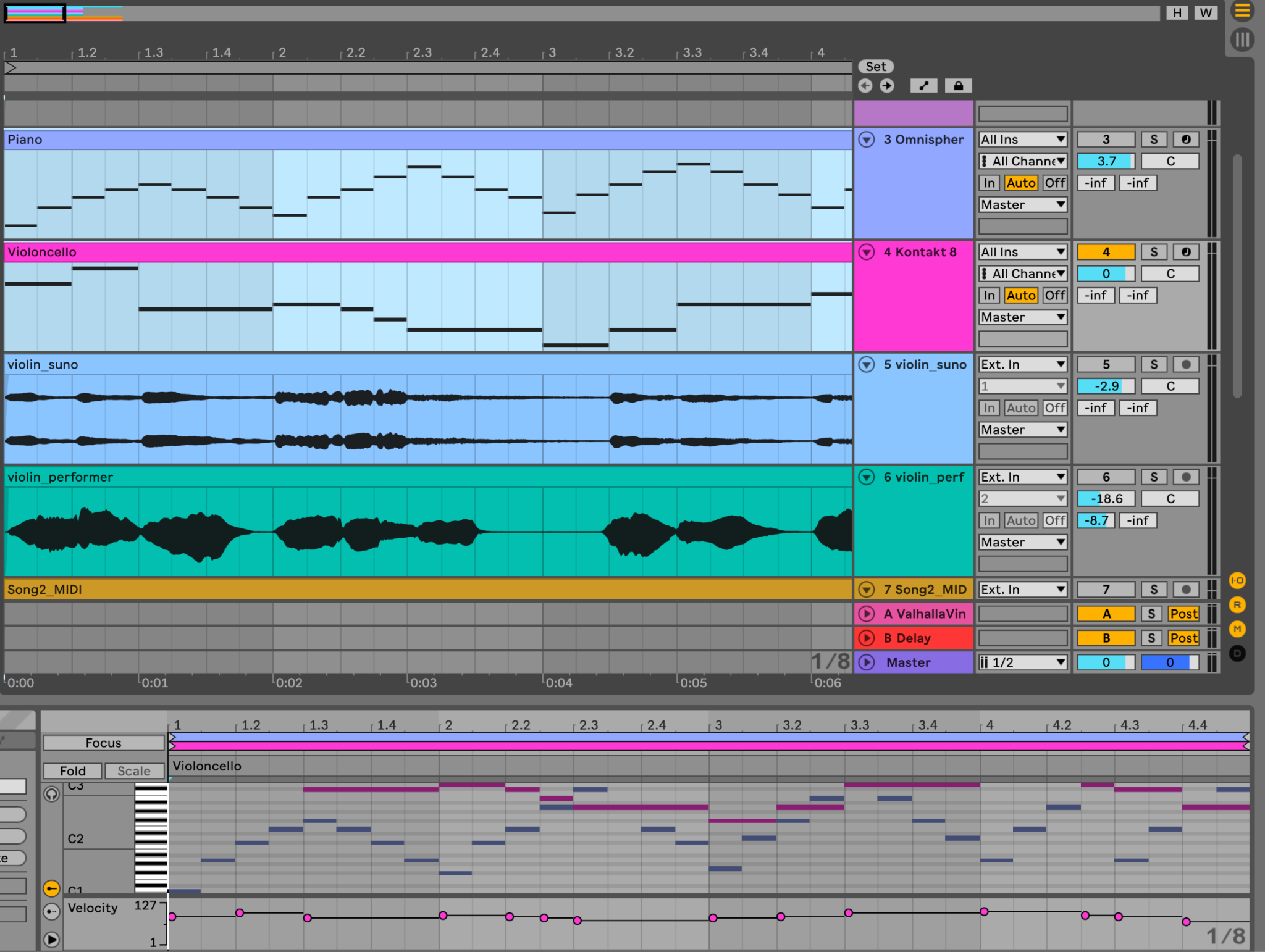
For the AI versions, I exported each dry solo MIDI part and used it as a reference in Suno’s Audio Remix feature. I tried several settings before settling on 80 to 85% Audio Influence, with prompts specifying the instrument and tempo. I selected a convincing take for each piece and used Get Stems to separate the solo part.
An independent instrumentalist recorded the human versions, following the MIDI reference at the specified tempo. Some rhythmic freedom was allowed for the flute to accommodate natural phrasing.
I used FabFilter Pro-Q 3 and Valhalla Vintage Verb for minimal EQ and reverb, aiming for consistency across sources. All six examples were matched to -22 LUFS integrated loudness with Youlean Loudness Meter 2.
Listening examples
Choose Flute or Violin, then select a version to listen.
Listening survey
The original listening survey presented each piece in three blind-listening rounds. Listeners identified the likely source as Human, MIDI, or AI, gave reasons, and rated naturalness, emotional expression, and technical accuracy on five-point scales. They also rated their confidence in the identification.
They could then switch freely between all three versions and choose a favorite. The instructions asked them to focus on the solo instrument’s technique and tone rather than the overall mix. After the source labels were revealed, they chose again and gave reasons for their preference.
The ten participants were aged 18 to 34. Seven worked in music, and five had at least ten years of formal training. Seven had previously used AI music tools. They listened on their own devices, including earbuds, headphones, and speakers.
Source identification
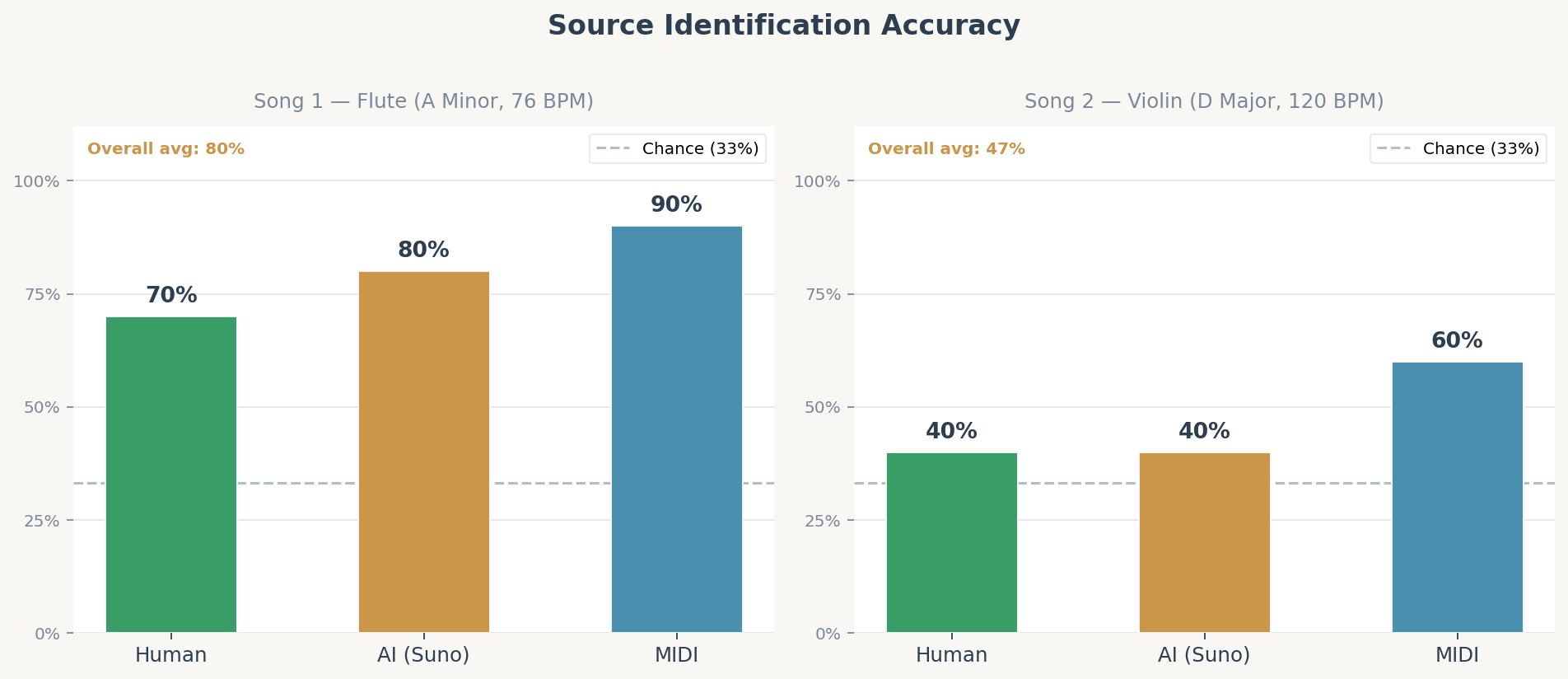
The flute recordings were easier to identify. Across the three versions, listeners correctly identified the source in 80% of responses. Nine of the ten recognized the MIDI version, eight recognized the AI version, and seven recognized the human performance.
For violin, overall identification was 47%. Four listeners correctly identified the human version, four identified the AI version, and six identified MIDI. Random guessing among three sources would average about 33%. The violin examples were harder to tell apart, but ten listeners are not enough to establish that the sources were perceptually equivalent.
Naturalness, expression, and accuracy
The human flute recording received the highest naturalness and emotional expression ratings, averaging 4.0 and 3.4 out of five. AI followed at 3.1 and 2.9, with MIDI at 2.7 and 2.5. Technical accuracy was closer across the three versions, ranging from 3.4 to 3.7.
The violin results were different. AI received the highest emotional expression rating at 3.6, compared with 2.4 for both the human and MIDI versions. Its naturalness score was also slightly higher than the human recording, 3.4 versus 3.1, while MIDI scored 2.6. Technical accuracy ranged from 3.4 to 3.7.
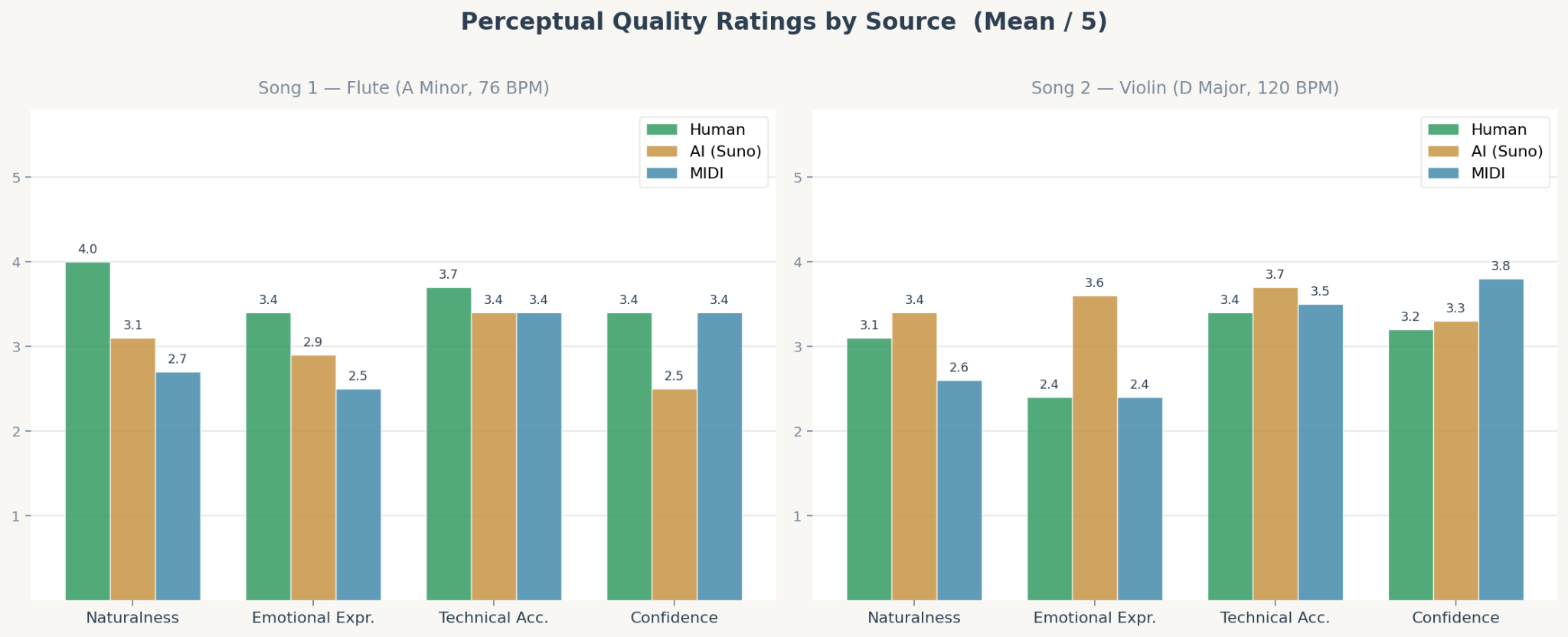
All scores are means on five-point scales. Confidence refers to source identification.
| Piece / source | Naturalness | Expression | Accuracy | Confidence |
|---|---|---|---|---|
| Flute / Human | 4.0 | 3.4 | 3.7 | 3.4 |
| Flute / AI | 3.1 | 2.9 | 3.4 | 2.5 |
| Flute / MIDI | 2.7 | 2.5 | 3.4 | 3.4 |
| Violin / Human | 3.1 | 2.4 | 3.4 | 3.2 |
| Violin / AI | 3.4 | 3.6 | 3.7 | 3.3 |
| Violin / MIDI | 2.6 | 2.4 | 3.5 | 3.8 |
Suno added ornaments to the violin melody that I had not written. Those additions may have contributed to its expression score, but the survey does not establish that explanation. They also make the comparison less controlled: listeners were judging differences in interpretation as well as the sound of each source.
Preference before and after disclosure
Five listeners preferred the human flute in the blind comparison, increasing to six after disclosure. AI received two votes in both conditions, while MIDI fell from three to two.
For violin, eight listeners chose AI before disclosure and six afterward. The human version rose from one vote to three, and MIDI stayed at one. Some listeners changed their minds after seeing the labels, but AI remained the most common preference for this piece.
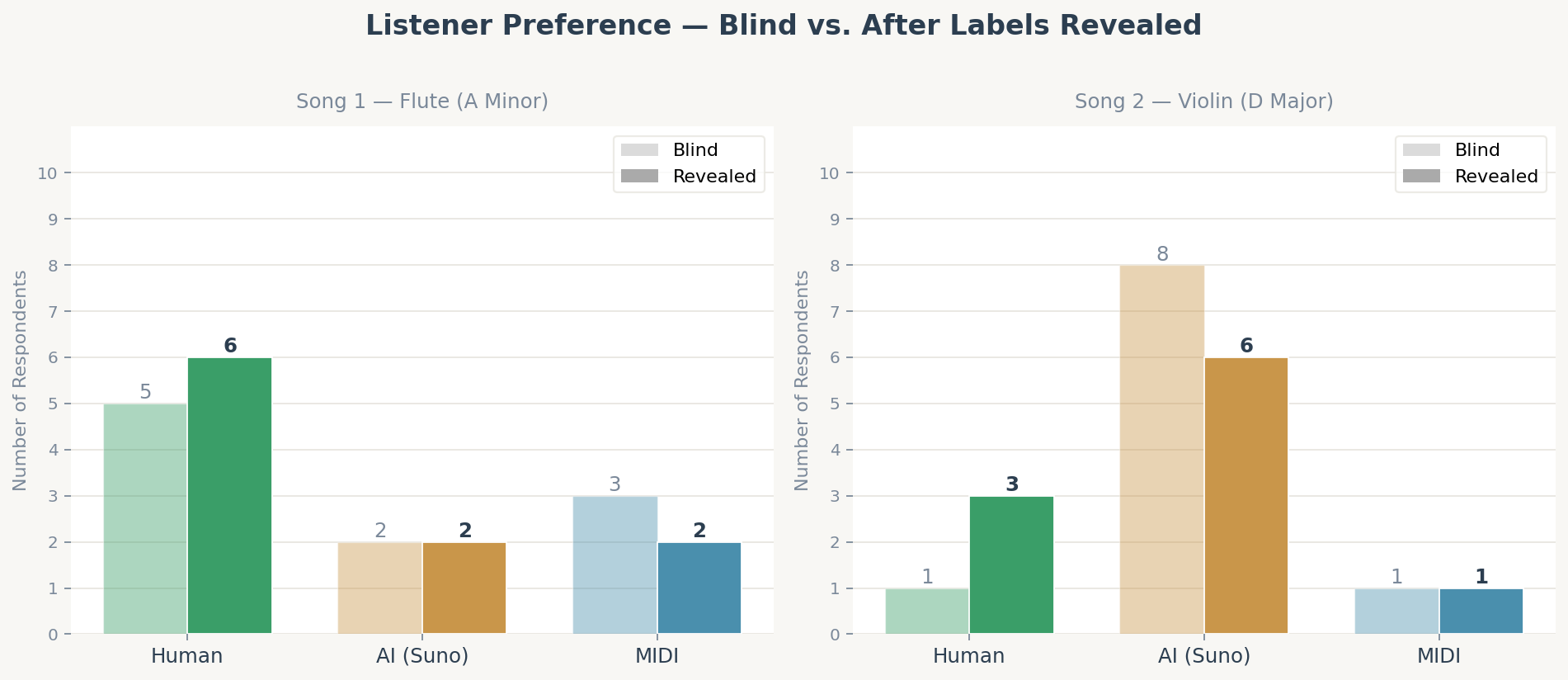
Listeners most often cited tone, natural timing, and details such as vibrato, phrasing, and bowing. Their reasons were similar before and after disclosure, although playing details received more attention once the sources were known.
Could AI replace a live musician?
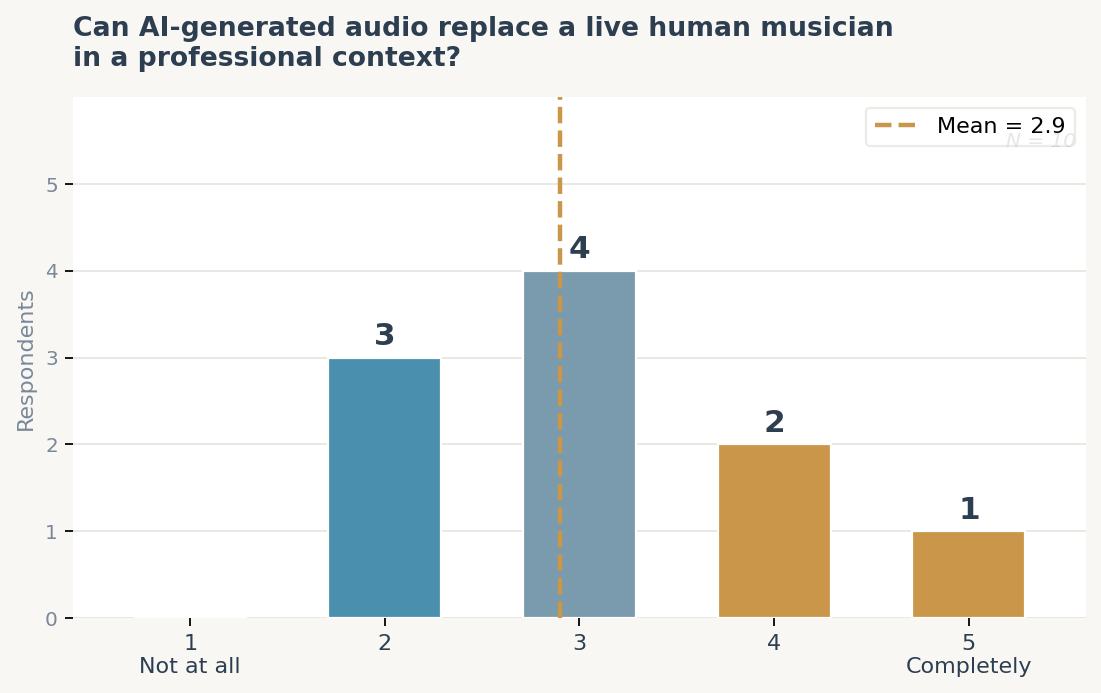
The final question returned to the practical concern behind the study: could AI-generated audio replace a live musician in a professional setting? Participants rated that possibility from one to five, with a reported mean of 2.9. The responses were more reserved than the preference for the AI violin might suggest. Enjoying one generated performance did not necessarily translate into endorsing AI as a substitute for a musician.
Discussion
The human flute was generally preferred, while the AI violin received higher expression ratings and more preference votes. For a producer considering AI as an alternative to a session musician, the contrast suggests that the instrument and the particular take matter more than a broad judgment about the source.
Suno’s added ornaments also raise a practical question: a performance can become more appealing while moving further from the written part. A follow-up study could ask listeners to judge expressiveness and fidelity separately.
This study used two pieces, one AI platform, and ten participants. I selected the AI takes, and playback conditions varied. A larger comparison should include multiple performers and generations under consistent listening conditions. The present results describe these examples rather than establish a general advantage for any source.
Thank you to the listeners who took part and the instrumentalist who contributed the live recordings.
A minor · 76 BPM · Flute and synthesized pad
D major · 120 BPM · Violin and piano
Unable to play this recording. Please try again.